Release
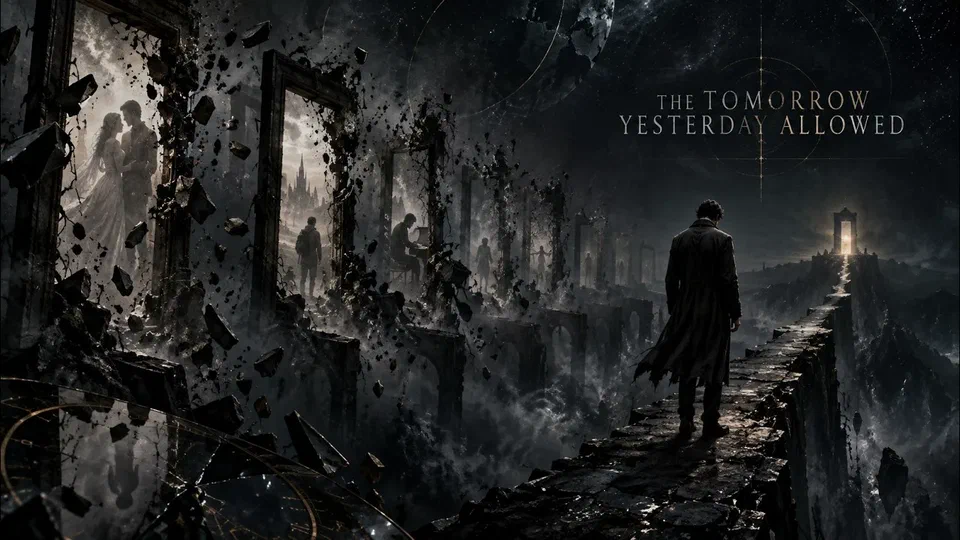
The Tomorrow Yesterday Allowed
A meditation on the futures that disappear while the places that once held them stay put.
Listen
Lyrics
Once, the world
waited behind every morning.
Every door
opened into another.
Every mistake
still had another year.
I said: later.
And later
was a country
without borders.
Now I can see
the first walls
on the horizon.
Not because I’m tired.
Not because I surrender.
Some roads
simply no longer exist.
I could go back —
but I could never return.
The street is still there.
The house.
Maybe even the light.
But the man
who might have lived there
is gone.
No grave.
No name.
No memory.
Only a life
that never learned
to breathe.
And suddenly
I understand:
Time does not pass.
It closes.
One door.
Then another.
Then another.
Quietly.
Forever.
We call it future
while there is still enough of it.
We call it fate
when the roads begin to disappear.
And one day
only one remains:
beneath black stars,
with all my unlived lives
walking behind me.
I do not mourn
yesterday.
I mourn
the tomorrow
that yesterday
still allowed.
Someday —
I thought
you were a place.
But you were only
another name
for the time
I still had.
The idea#
The song is an elegy for a future that once seemed available. Its opening gives time the features of a landscape. Mornings open like doors, “later” has the breadth of a country, and a mistake can still be absorbed by another year. When walls appear on the horizon, the metaphor makes a change in the speaker’s sense of possibility visible as a change in the lay of the land.
The surviving street and house sharpen that loss. A person can go back to an address and still be unable to return to the life they might have led there. The threefold repetition of “No” gives that unrealized self a kind of funeral litany. Later, the image of unlived lives walking behind the speaker makes their absence felt as a presence. These are possibilities with enough emotional weight to haunt the one life that took shape.
Toward the end, the isolated phrases enact the closure they describe. Door after door falls on its own beat, and “Someday” receives a final address as though it were a place or a person the speaker could still reach. The title names the object of grief with particular precision. Yesterday is the last vantage point from which that other tomorrow was still possible.